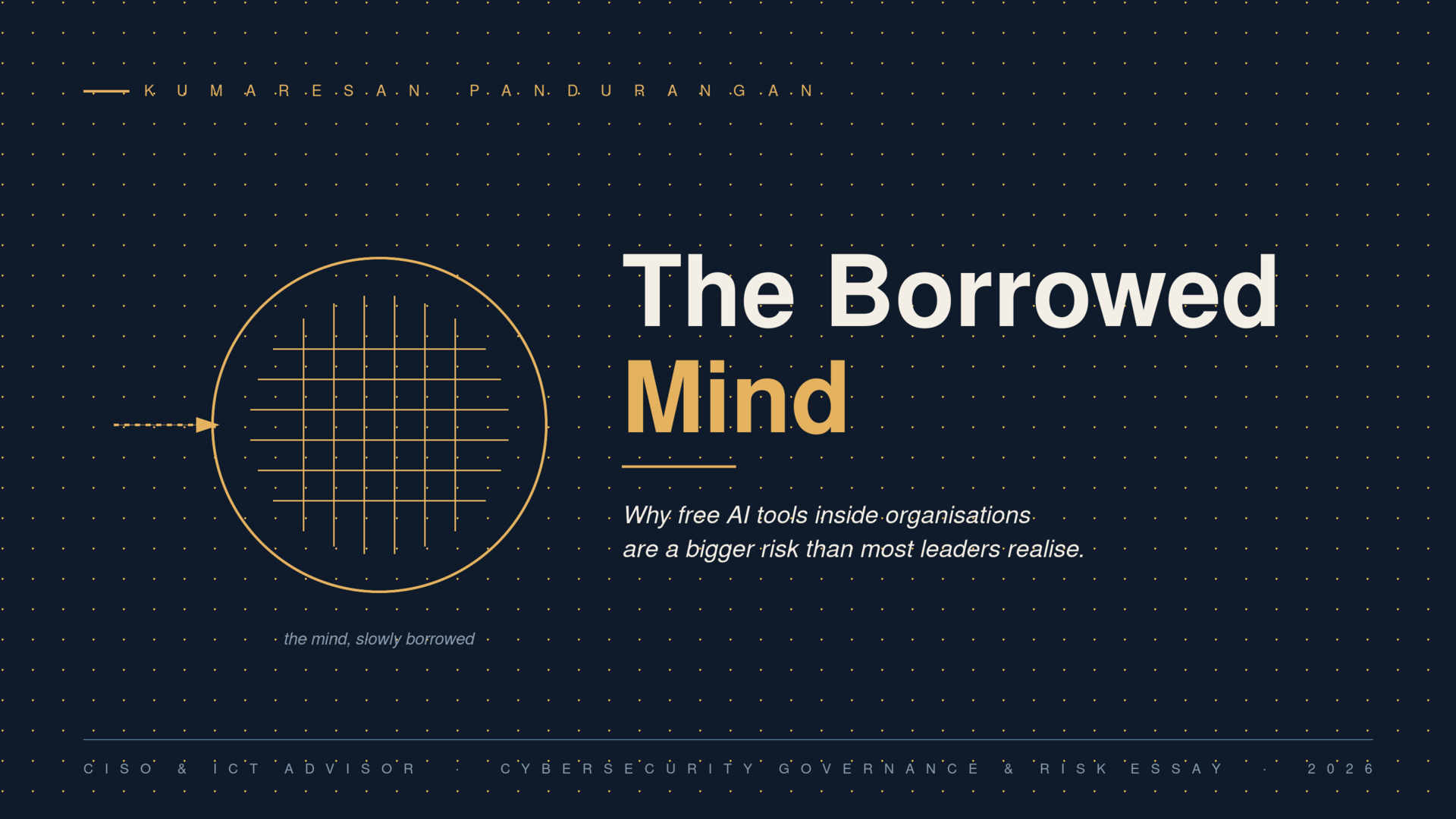
The Borrowed Mind
For years, organisations have treated AI inside the workplace as a productivity question. Should we use it? How fast? Which team first?
These are the wrong questions.
The real question is being answered every day, without leadership in the room. In every department, employees are quietly handing over their work, their data, and slowly, their thinking, to AI tools the organisation has never approved, never trained anyone on, and in many cases, never even named.
A marketing manager pastes the unreleased product brief into ChatGPT to "polish the language." An HR executive types a sensitive employee complaint into Gemini for a "balanced summary." A developer drops proprietary code into a free AI tool to fix a bug.
None of them are doing anything wrong. They are trying to work faster.
That is exactly the problem.
The Quiet Leak
Free public AI tools were never built for your secrets. Many of them log, store, and depending on the tool, train future models on whatever is typed in. Customer data, strategy notes, contracts, code, HR records, all of it leaves the organisation through a window your security team did not know was open.
Once it is out, you cannot pull it back. You may not even know it has gone.
The Borrowed Mind
The deeper risk is harder to see.
It begins small. An employee asks AI to "polish the language." Then to "tighten the argument." Then to "tell me what to recommend."
Slowly, the tone of the work changes. Then the reasoning. Then the personality.
The voice of the person on the ground, the one who actually met the customer and sat in the room, fades. What lands on the leader's desk is a smooth, generic output written by a model trained on someone else's data and someone else's worldview.
The colleague becomes, in effect, a personality controlled by AI. The organisation stops hearing from its own people.
That is the borrowed mind. Once it sets in, it is very hard to undo.
Why It Happens
This is not an employee failure. It is a leadership gap.
There is no clear policy on what tools may be used and what may be typed in.
There are no approved enterprise tools, while the work still has to get done.
There is no training, so people use whatever sits one tab away.
When the easy tool is free and unwatched, using it becomes the rational choice, not the careless one.
What Leaders Should Do
Blocking everything does not work. People will simply use their phones.
Write a clear, one-page AI usage policy. Name the approved tools. Say what may be put in and what must not.
Provide proper enterprise tools. The cost of one paid licence is nothing next to the cost of one serious leak.
Train people in plain language, with real scenarios. Refresh it every six months.
And protect the voice of the people on the ground. Reward original thinking. Be a little careful with polished documents that arrive without fingerprints.
The Self as Friend, the Self as Enemy
There is a timeless principle in the Bhagavad Gita worth holding close.
“Uddhared ātmanātmānaṁ nātmānam avasādayet.”: Let a person lift themselves by their own self, and not let themselves fall.
The model can polish words and shape arguments. It cannot lift the self. Only the self can do that. Every time judgment is handed over without thought, the self quietly becomes less of a friend and more of an enemy.
The Bottom Line
AI is useful. The question is who is in charge.
Free tools will not pause to ask whether your data should be theirs. Models will not pause to ask whether your judgment is being weakened. Employees will not pause unless leaders give them a clear policy, a real tool, and a reason to think for themselves.
The question every leader must keep asking is the simplest one: who is in charge here, the human or the model?
If we cannot answer that, we have a much bigger problem than a data leak.
← Back to writing