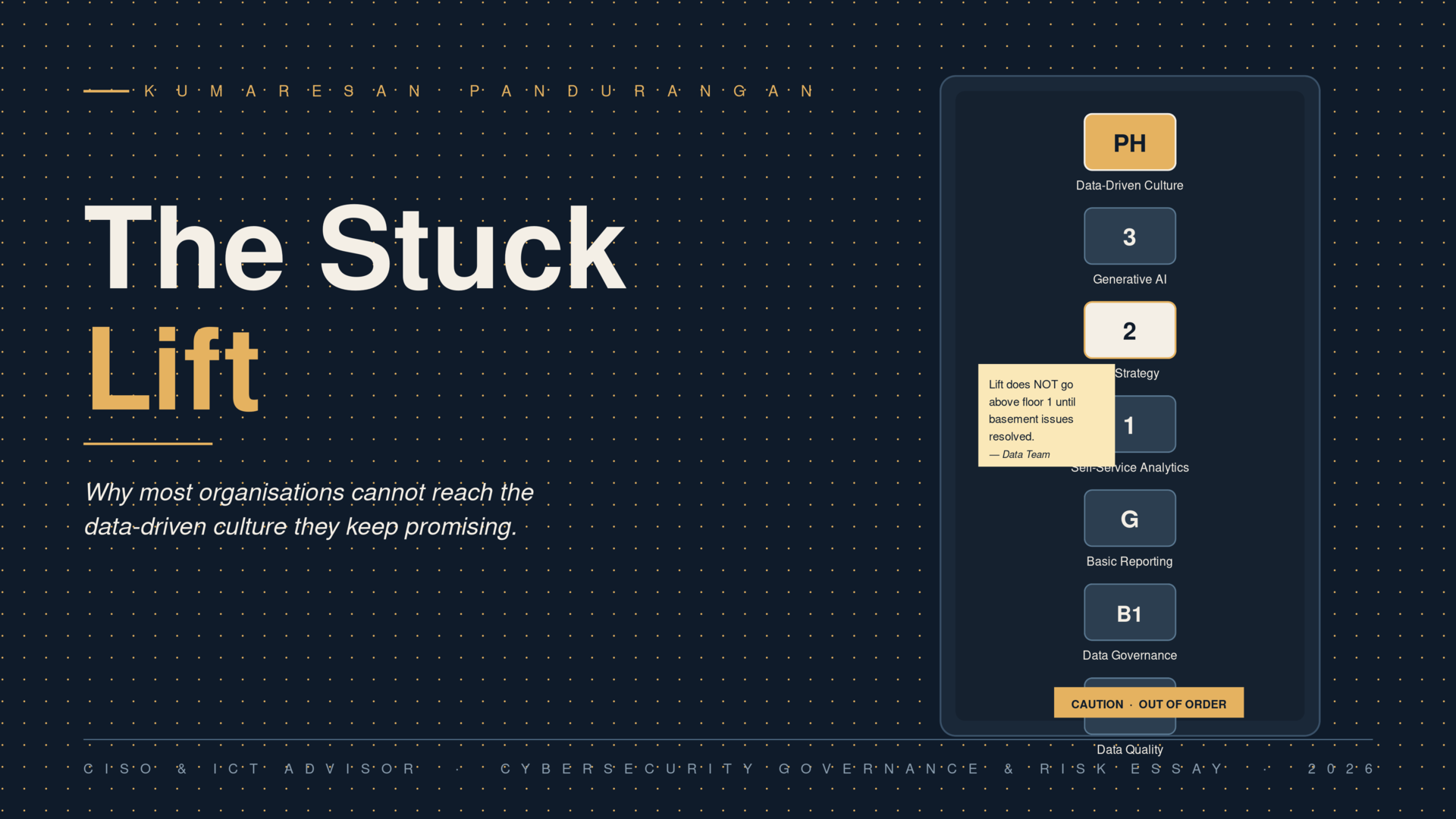
The Stuck Lift
For years, organisations have been racing toward a Data-Driven Culture as if it were a destination at the top of a building. They invest in AI Strategy. They fund Generative AI pilots. They hire Chief Data Officers, sign roadmaps, and announce the journey.
And yet, the lift will not move.
The reason is rarely complicated. The floors below the top are broken. Data Quality is taped off. Data Governance is in the basement and ignored. Basic Reporting is shaky. The AI Strategy floor is brightly lit, but it is hanging over nothing.
The Stuck Lift
Picture the lift in any modern organisation today.
The Penthouse is "Data-Driven Culture." Everyone wants to reach it. Below it sit Generative AI and AI Strategy, the buttons that get pressed every day in board meetings. Below those: Self-Service Analytics, Basic Reporting, Data Governance in the basement, and Data Quality, sealed off with yellow tape.
Taped to the panel is a quiet little note from the Data Team:
Lift does not go above floor 1 until basement issues resolved.
That note never gets read out in the AI strategy meeting. It does not appear on the executive scorecard. Yet it explains, more honestly than any dashboard, why the organisation keeps announcing transformations that do not transform.
The Cool Snacks Problem
There is an exact parallel in how organisations have always tried to build culture.
You do not build culture with cool snacks. You do not build it with company swag, casual Fridays, or motivational posters in the lobby. These are the visible, easy things. They are the floors near the top.
Culture is built somewhere else. It is built by talking to employees. It is built by listening to what they actually say. It is built by caring whether they are succeeding, not just whether they are present. It is built when concerns raised in a survey are answered, not filed.
A Data-Driven Culture is no different. It cannot be ordered from the AI Strategy floor any more than a Great Place To Work can be ordered from the snack bar.
Why Leaders Keep Pressing the Top Buttons
Pressing the top floor is fast. It is visible. It is what the board and the LinkedIn audience want to see.
Pressing the basement is slow, unglamorous, and produces no announcement worth making.
Quality is invisible work. Governance is invisible work. Listening to employees is invisible work. None of it lands well in a quarterly update.
The cost never disappears. It simply goes downstairs and waits.
Rebuilding From the Basement
Leaders rebuild the lift when they fund Data Quality and Data Governance with the same seriousness as a GenAI pilot. The cost of one model going wrong on bad data is far higher than the cost of cleaning the data.
They rebuild it when they treat Basic Reporting and Self-Service Analytics as the walls everything above stands on, not as old, boring layers.
And they rebuild it on the people side too, when they stop confusing perks with attention, listen to honest feedback, and reward truth-telling, not just compliance.
Duty Before Dazzle
There is a timeless principle in the Bhagavad Gita that speaks directly to this.
“Niyataṁ kuru karma tvaṁ karma jyāyo hy akarmaṇaḥ.”: Perform your prescribed duty, for action is greater than inaction.
The duty of leadership in this moment is not to celebrate the floor everyone wants to live on. It is to walk into the basement, do the work that nobody applauds, and keep doing it. The reward comes only from the action, never from the announcement of it.
The Bottom Line
Most organisations do not have an AI problem. They have a basement problem.
A Data-Driven Culture cannot be reached by pressing harder on the AI Strategy button. A strong people culture cannot be reached by adding another casual Friday. Both are penthouses. Both depend on floors most leaders find too unfashionable to visit.
The work is downstairs. The work has always been downstairs.
Until leaders walk into the basement, talk to the people who actually live there, and fix what is broken, the lift will keep blinking on floor 1, and the penthouse will remain a poster on the lobby wall.
← Back to writing